

The transition from Contract for Difference (CFD) award to Final Investment Decision (FID) represents one of the most critical phases in the lifecycle of an offshore wind project. While securing a CFD provides a route to revenue certainty, converting this milestone into a fully executable, bankable project is often where timelines and budgets come under the greatest pressure.
At GMEC, we are seeing an increasing demand from developers, investors, and contractors for targeted support in this high-stakes stage.
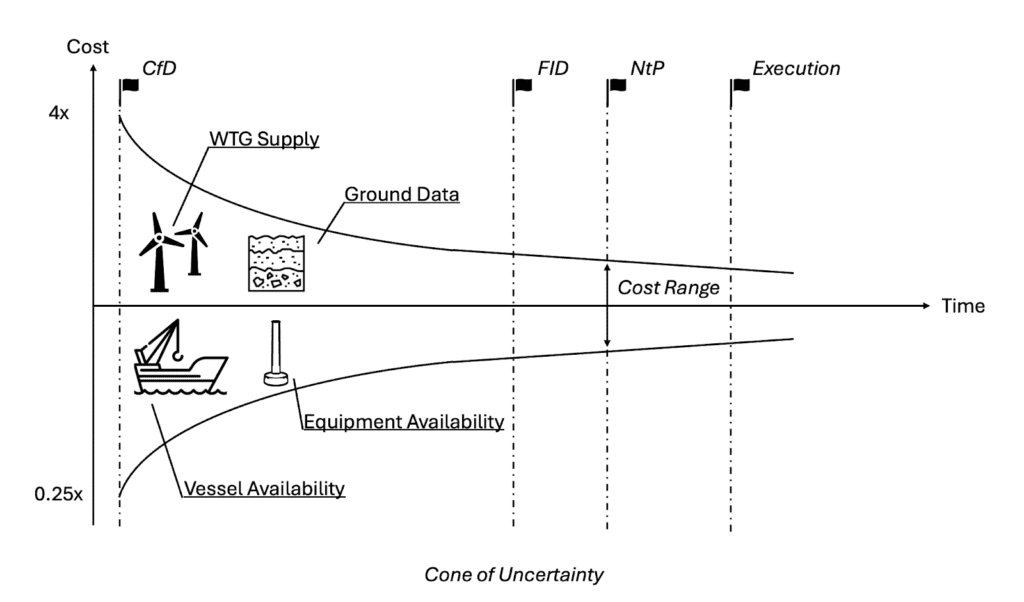
Why the CFD–FID Phase Matters
- Risk Concentration: Technical, commercial, contractual and supply chain risks converge between CFD and FID, and decisions made here ultimately dictate the financial outcome of the project.
- Contract Readiness: A project may have regulatory approval and CFD support, but if contracts are not aligned, enforceable, and fully executable, FID can be delayed or in the worst case terminated — adding cost and uncertainty.
- Investor Confidence: Lenders and investors require assurance that all technical and contractual elements have been independently validated before funds are committed.
Our Role in De-Risking the Journey
Our team brings decades of offshore construction and contract management experience directly to this phase. We work alongside developers to:
- Conduct third-party due diligence on engineering, contracting, and scheduling assumptions.
- Identify and close gaps in interface management that could delay execution and/or create opportunities for claims.
- Benchmark CAPEX build-ups and validate contractor scopes for realism and deliverability.
- Lead lessons-learned workshops from past projects, ensuring avoidable mistakes are not repeated.
Recent Example
On a UK Round 3 offshore wind project, GMEC partners were directly involved in reviewing and finalising the contractual documentation for the foundations EPCI contract. Our recommendations allowed the developer to align key interfaces, saving significant contingency costs and giving the investment committee confidence to approve FID on schedule. The project has since been successfully delivered.
Looking Ahead
As the UK and European offshore wind sectors expand rapidly toward 2030 targets, more projects will move through the CFD-to-FID bottleneck in the coming years. The ability to identify and manage the key risks and realise the key opportunities will separate the financially successful projects from those that stall.
GMEC is committed to helping developers bridge this critical gap with certainty – ensuring that the transition from the CFD milestone translates into a robust and bankable FID.
Contact our team to discuss how we can support your CFD-to-FID transition: info@gmec-energy.com